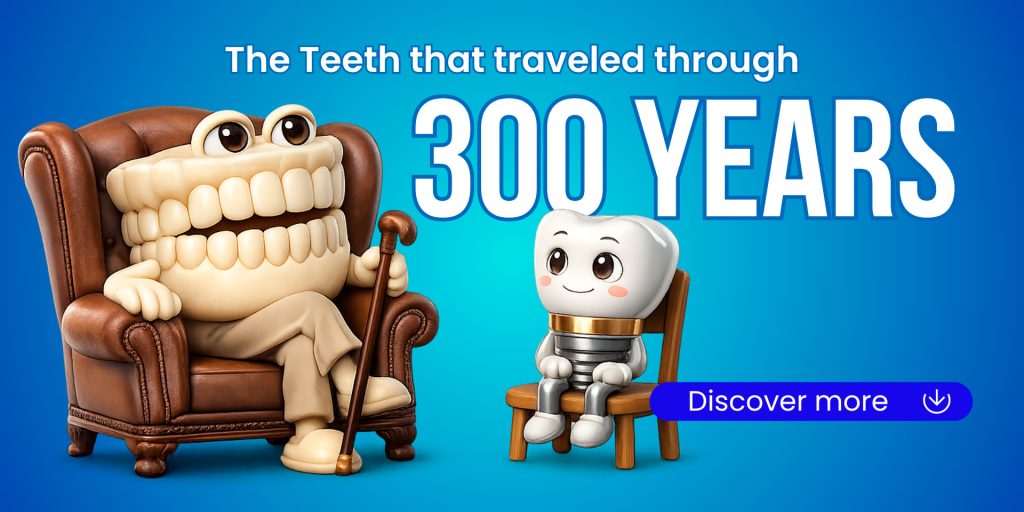
Imagine wearing a tooth carved from an elephant’s tusk. Now imagine that same tooth slowly rotting in your mouth, producing a foul smell and an even worse taste. This was the reality for wealthy Europeans in the 18th century. Elephant ivory dentures were a luxury item, but they came with a disgusting price: rapid deterioration, biological incompatibility, and inevitable failure .
The quest for replacement teeth led to even darker practices. After the Battle of Waterloo in 1815, thousands of young soldiers lay dead on the battlefield. Body snatchers descended upon the corpses, yanking out teeth to sell to dentists. These so-called “Waterloo Teeth” were then mounted on ivory bases and fitted into the mouths of the rich . The demand was so high that battlefields became prime sources for human teeth throughout the 19th century.
The irony is heartbreaking. The wealthy paid fortunes for dentures made from the teeth of dead soldiers and decaying ivory. These prosthetics never fit properly, wobbled with every bite, and required constant replacement. A full upper denture from that era, now preserved in the Science Museum in London, shows clear signs of “intraoral decay” . It was unsightly, foul-smelling, and ultimately useless.
Everything changed in 1952, thanks to a Swedish orthopedic surgeon named Per-Ingvar Brånemark. While studying blood flow and bone healing in rabbits, he inserted titanium optical devices into their femurs. When he tried to remove them, something miraculous happened: the titanium had fused permanently with the living bone . He called this process “osseointegration,” and it would revolutionize dentistry forever.
In 1965, Brånemark placed the first successful titanium dental implant in a human patient—a man with a cleft palate and no teeth in his lower jaw. The implant integrated perfectly. When the patient passed away in 2005, forty years later, those titanium roots were still firmly anchored in his bone, fully functional . Today, the longest follow-up study in dental history (38-40 years) confirms that modern implants have a survival rate of over 95% after four decades .
The contrast could not be starker. A 300-year-old ivory tooth traveled through history as a museum relic—fragile, decaying, and ultimately a failure. A modern titanium implant, placed at Mayo Dental Clinic in Mexicali, is designed to last a lifetime. No wobbling. No bad smells. No stolen teeth from dead soldiers. Just strong, stable, natural function that integrates with your own body.
At Mayo Dental Clinic, we don’t do relics. We do results. Cross the border to Mexicali and experience dentistry that actually works. Your smile deserves the modern solution.